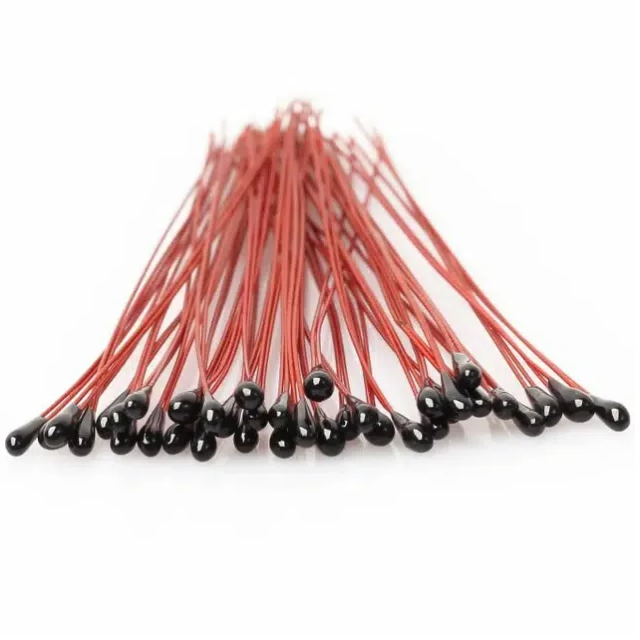
When it comes to designing systems that require accurate temperature control or thermal protection, the type of thermistor sensor you select can significantly affect the overall performance and safety of the product. Whether it’s a consumer device, an HVAC unit, a medical instrument, or industrial equipment, engineers and decision-makers must carefully choose between NTC and PTC thermistors. These two types differ in function, behavior, and best-use scenarios. At ShenZhen HaiWang Sensor Co., Ltd. & HW INDUSTRIAL CO., LTD, we’ve supported global clients for over two decades in selecting and customizing the right thermistor sensor for their needs.
What Distinguishes NTC from PTC?
NTC and PTC thermistors are both types of resistors that change resistance depending on temperature. However, they behave in opposite ways and are designed for different roles in electronic systems.
NTC stands for Negative Temperature Coefficient. This means that as the temperature increases, the resistance of the thermistor decreases. This behavior makes NTC thermistors especially useful for applications that require real-time temperature monitoring and control, because the resistance change is smooth, predictable, and highly sensitive to even slight temperature shifts. This makes it easy to track temperature values over a defined range.
On the other hand, PTC stands for Positive Temperature Coefficient. As temperature rises, the resistance of a PTC thermistor increases. At a certain threshold temperature, the resistance increases sharply. This self-limiting behavior makes PTC thermistors perfect for overtemperature protection and self-regulating heating elements. They are less about measuring exact temperature and more about acting like a thermal switch or safety component.
In summary, NTC thermistor sensors are designed for precise temperature sensing, while PTC thermistors are designed for circuit protection or heating control.
When to Use NTC Thermistors
NTC thermistors are ideal for applications where accurate temperature data is required for monitoring, regulation, or feedback loops. Their sensitivity, reliability, and cost-efficiency make them highly popular across a wide range of industries.
In HVAC systems, NTC thermistor sensors are embedded in air conditioners, heaters, and thermostats to regulate room temperature. These sensors provide real-time data that allows the system to adjust airflow or heating levels, maintaining comfortable conditions while maximizing energy efficiency.
In the medical field, NTC sensors are used in devices such as incubators, patient monitors, and sterilization equipment. The ability to accurately detect even small changes in body or environmental temperature is crucial to ensuring patient safety and equipment performance.
In consumer electronics, these sensors are used to monitor the temperature of batteries, processors, and chargers. For example, in smartphones or laptops, NTC thermistor sensors prevent overheating by sending signals to the system when a threshold is reached, which may trigger cooling fans or reduce processing power.
In automotive electronics, NTC thermistors monitor engine coolant temperature, cabin air, and battery packs. In electric vehicles especially, maintaining the right thermal environment extends battery life and ensures driving performance.
Whenever you need consistent, responsive, and accurate measurement of temperature within a certain range, an NTC thermistor sensor is typically the best fit.
When to Use PTC Thermistors
While NTC thermistors are all about monitoring, PTC thermistors are designed to react. Their unique self-regulating behavior makes them suitable for protective or heating roles where safety and stability are key.
In overtemperature and overcurrent protection, PTC thermistors act as resettable fuses. For example, in power supplies or electric motors, if current levels get too high or the unit starts to overheat, the PTC sensor’s resistance spikes. This reduces current flow and protects other components from damage. Once the system cools down, the thermistor returns to its original resistance and resumes normal operation, eliminating the need for manual reset or replacement.
PTC thermistors are also widely used in self-regulating heating elements. These are common in heating pads, automotive seat warmers, pipe defrost systems, and similar products. The PTC thermistor ensures that once a preset temperature is reached, the heating slows down naturally without requiring complex electronic control systems. This makes them ideal for simple, energy-efficient heating devices.
In industrial applications, such as transformers or large motors, PTC thermistors protect equipment from dangerous temperature spikes. Once the internal temperature crosses the safe operating range, the thermistor triggers a control response or shutoff, preserving machinery and reducing downtime.
If your project needs automatic thermal cutoff, heating regulation, or resettable circuit protection, the PTC thermistor is the right tool.
Key Differences Without a Table
While both NTC and PTC thermistor sensors are highly reliable and valuable in electronics, the way they work and the applications they serve are quite distinct.
An NTC thermistor will decrease resistance as it heats up. This makes it highly useful for accurate temperature measurement in systems that need continuous monitoring. It reacts quickly to environmental changes and works well in devices that operate within a narrow to medium temperature range. NTCs are generally low in cost, small in size, and very energy efficient. However, they are best suited for systems that do not require operation beyond certain thermal limits.
In contrast, a PTC thermistor increases its resistance as it heats up. This is more suitable for triggering protection mechanisms or limiting current flow without needing external control logic. PTC thermistors are also used where heating stability is needed. Their resistance increases sharply after a set point, which makes them perfect for self-regulating heaters or circuit protection. While they may be slightly more expensive than NTCs, their ability to act as a passive safety system often justifies the cost.
How to Decide for Your Project
If you’re designing a new product or optimizing an existing one, choosing the right thermistor sensor type is crucial. Here are some key questions to guide your decision-making process:
What is the primary goal of the thermistor? If it is to measure temperature accurately and provide feedback, then the NTC is the correct choice. If the goal is to limit or cut off current flow in response to heat, then a PTC will serve better.
Is the operating environment stable or variable? For highly variable temperatures where you need precise control (e.g., medical or HVAC applications), go with NTC. For rugged environments where protection and durability are the focus (e.g., industrial equipment), PTC may be the better solution.
Do you need real-time feedback or just reaction? If your system needs to know and respond to exact temperature values, use NTC. If your system just needs to shut down or slow down when it gets too hot, use PTC.
What are your size and power requirements? NTC thermistors are generally smaller and consume less power, making them ideal for embedded systems and portable devices.
At ShenZhen HaiWang Sensor Co., Ltd. & HW INDUSTRIAL CO., LTD, we not only manufacture both NTC and PTC thermistor sensors but also offer full customization options. Whether you need special packaging, unique resistance values, waterproof coatings, or integrated wiring solutions, we can provide thermistor sensors tailored to your exact specifications.
Our engineering team works closely with clients across a wide range of industries—including automotive, industrial automation, energy, HVAC, and healthcare—to ensure they get a solution that’s optimized for both performance and durability.

Conclusion
Selecting the right thermistor sensor is essential for creating efficient, safe, and high-performing electronic systems. Use NTC thermistors when you need fast, accurate, and continuous temperature monitoring. Choose PTC thermistors when protection, thermal cutoff, or self-regulating heating is required. Understanding the difference helps engineers and system designers avoid costly design errors and maximize product performance.
At ShenZhen HaiWang Sensor Co., Ltd. & HW INDUSTRIAL CO., LTD, we offer both standard and custom NTC and PTC thermistor sensors, built with industry-leading precision and reliability. Whether you're creating a next-generation consumer device or protecting an industrial power unit, our thermistor sensor solutions are ready to meet your needs.
Contact us today to explore our thermistor sensor product lines or request a customized solution that fits your specific application.